

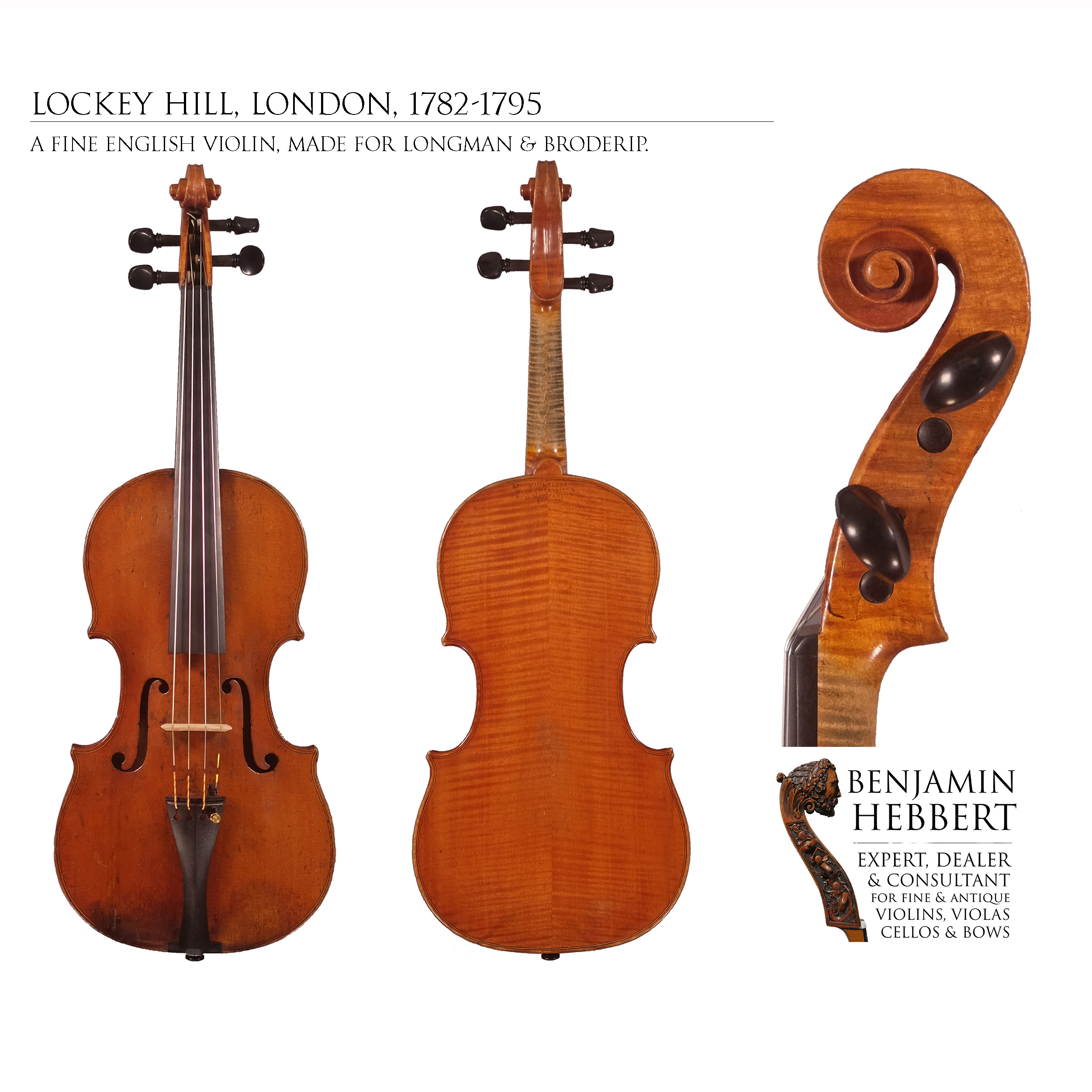
Description
A fine English violin by Lockey Hill, London, between 1782 and 1795.
Stamped: Longman & Broderip / No 26 Cheapside / No 13 Haymarket / London
Lockey Hill (b. 1756, d.1796) is one of the more distinguished English violin makers of the late eighteenth century, producing a prolific number of instruments, and an early member of the family that would become W.E. Hill & Sons a century after this violin was made. Lockey’s violins come in two models, Stainer and Amati and this is the latter sort. In truth there is little that critically compares these instruments with the prototypes to which they aspire, but the modelling of the arching and subtle differences in the soundholes help to reference these concepts. Otherwise he stuck with a fairly individual pattern, of which this is a very good example. Although these look a little bit idiosyncratic, this example lives up to their superb reputation for sound.
Many of Lockey Hill’s violins were made for wholesale to the London trade, and this one bears the brand of Longman & Broderip, who were prestigious musical instrument sellers specialising mostly in pianofortes. James Broderip was involved in different partnerships from as early as 1767, but this particular partnership existed only between 1782 and 1795.
This is a great little violin to play, with tremendous response and a bright, very resonant sound that punches considerably above it’s weight.
Certificate: Our certificate available upon purchase.
Condition notes: The violin is in as-new condition, but often when an old instrument appears in such crisp and fresh condition it is because it has been stored for a long time in the past, with the risk of woodworm. There are a few woodworm tracks in the belly that were restored long ago and and the worm poses no further risk, but the violin is otherwise in outstanding condition. The violin is priced accordingly.
.
Literature: This instrument was loaned for an exhibition of work by the Hill family, as part of the Entente Internationale des Maitres Luthiers et Archetiers d’Art in 2024 as an exceptional example of its type. An example is illustrated in The British Violin (2000).

CONTACT US
If you are interested in this instrument please email us here:


