




Description
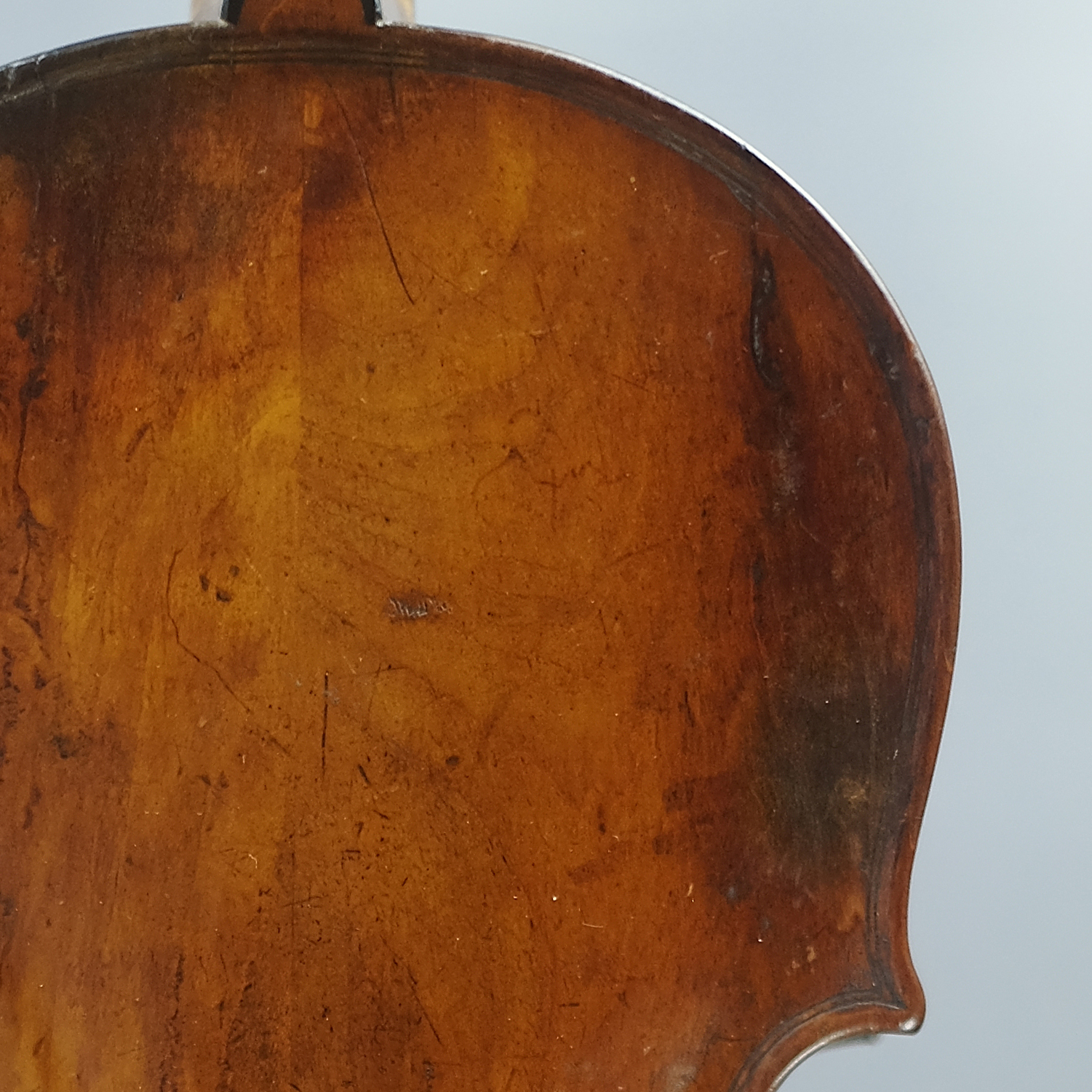
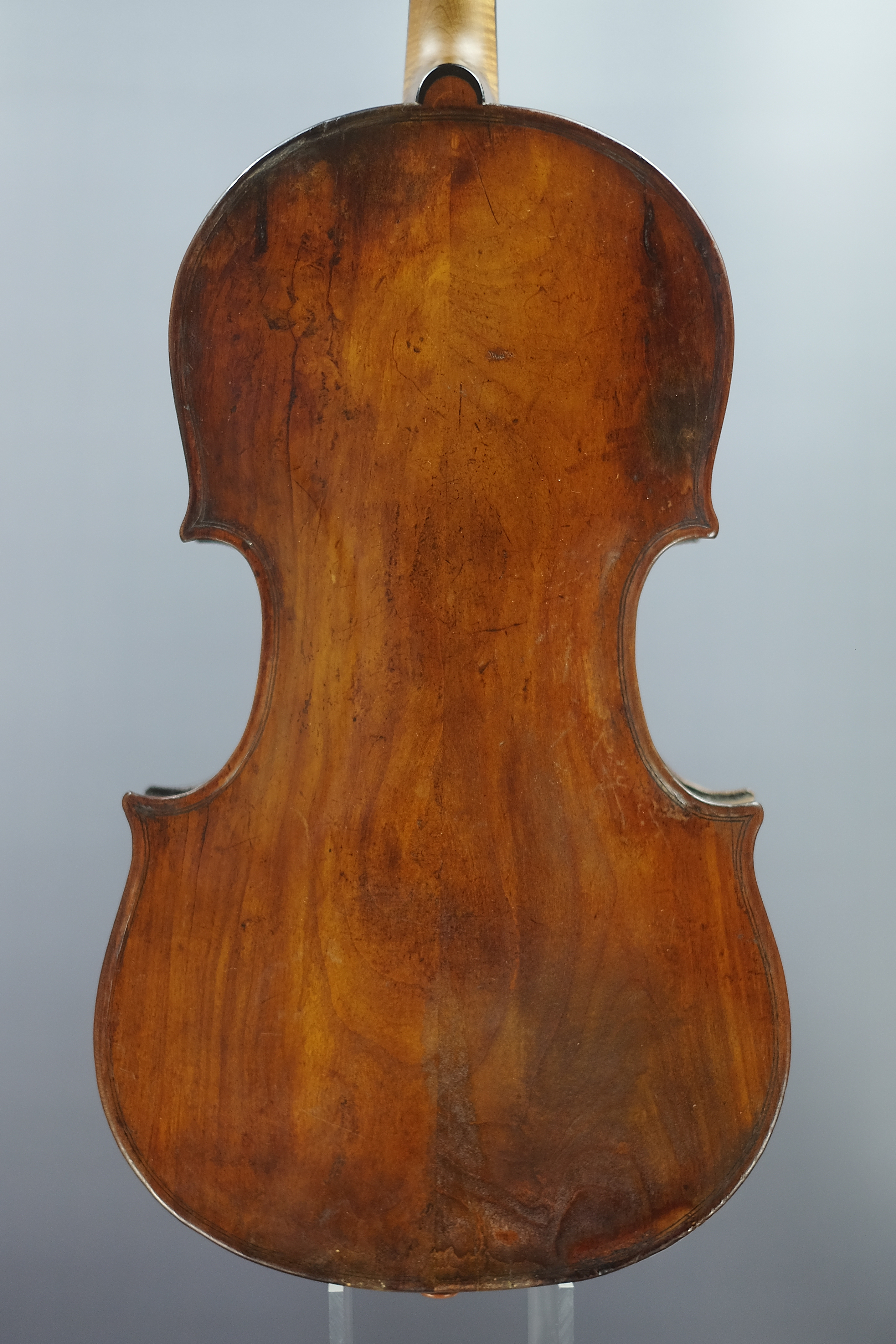
A composite viola after Guarneri del Gesù made by Jack Lott, comprising the back and ribs of Bartolomeo Pasta, Milan, circa 1675-1700. (LOB 412mm)
Labelled: Bearing the facsimile label of Carlo Antonio Testore figlio maggiore / del Carlo Giuseppe in Contrada / larga al segno dell’Aquila. 1747
It is incredibly rare to find an old viola of full Cremonese contralto dimensions, and this offers an opportunity to find such an instrument for less than the millions of dollars that these usually run to. The dimensions of the back are extremely similar to those of the 1672 “Mahler” viola and the 1690 Tuscan Medici by Stradivari. It is not possible to date the instrument precisely, but if I were to be pressed on it, I would err towards a date closer to 1675 than 1700.
Measurement given on the left below; 1672 Mahler (left) 1690 Tuscan Medici (centre) and Pasta (right).
- Length of Back: 41.2cm / 41.4cm / 41.2cm
- Upper bout width: 19.6cm / 18.7cm / 19.4cm
- Middle bout width: 13.5cm / 13.1cm / 13.5cm
- Lower bout width: 25.0cm / 24.3cm / 24.1cm
The back (which is the most important acoustical part) and ribs of the instrument are the work of Bartolomeo Pasta (c.1640 – c.1706), a pupil of Nicolo Amati in Cremona in 1660, around the same time as Giovanni Battista Rogeri. He evidently worked within the Amati workshop until 1673 he settled in Milan (in the same house as Testore), where his sons were born. His instruments are very rare, but they demonstrate a thorough understanding of the Cremonese style.
In the nineteenth century when it was re-made by the legendary English forger, Jack Lott, he obviously intended it to pass for a late-period example of the work of Giuseppe Guarneri del Gesù. There are several genuine examples with more exaggerated soundholes including the 1741 “Vieuxtemps”, 1742 “Dushkin”, the 1744 “Lord Coke” and “Ole Bull”, all of whom have elements that could have inspired these soundholes. The exaggerated asymmetry of how they are set on the belly is a reflection of many violins by del Gesù in the 1740s period. Of interest there is another important viola, made by Alessandro Gagliano that Lott adapted by recutting the soundholes in a simiilar manner to pass as a del Gesù. In this case, the instrument was subsequently owned by Vuillaume who may have considered it genuine, for at the end of his life he attempted to sell it along with the Messiah to one of his most valued customers, Monsieur Fau of Castres writing in 1874 that he has finally decided to sell him his ‘famous Joseph Guarnerius viola… of splendid aspect and distinctive tone’ for 4,000 Francs. A study of the soundholes of these two instruments suggests that Lott cut them from the same template.
The head is from a different German instrument. It is not intended to match the instrument in any way, and by being an obvious misfit it doesn’t distract from a reading of the instrument, making the forgery more successful: Although when it first came to my attention any notion of it being a del Gesù was long gone, and it already had a long and different history as a Testore.
Most classical Italian makers used dyed pearwood to make the black strips for the purfling, but whilst it was a wood that is common to all makers, it is rarely seen in the significant parts of instruments, probably because it was known to be more susceptible to woodworm than maple, so less attractive to purchasers. Towards the end of Stradivari’s time it is found on the head of the 1698 De Kermadek Bläss and 1726 Comte de Saveuse cello and more significantly the back of the 1736 Spencer-Dyke violin (he used pearwood to make the rosettes of his few mandolins and guitars). It is a wood that was continually experimented with for its acoustic qualities which are darker and fuller – more suited to the viola. The original ribs are of Italian poplar, which is common amongst both Cremonese and Milanese cellos in this period. I note the absence of Cremonese locating pins, but despite his training in Cremona these don’t seem to have been an essential part of his working methods.
Certificate: Benjamin Hebbert
Condition notes: The instrument is overall in very good condition with the exception of the back. It is difficult to find pearwood that is large enough to yield a viola back, and this piece of wood has a number of fissures in the top-bouts that are related to knots, sap pockets and inclusions. These are natural to the wood, and stabilised internally on the bass side where they are most prominent with an internal patch. The viola priced to take the repairs into consideration.

CONTACT US
If you are interested in this instrument please email us here:


